One of the common complaints and fears right now in Social Media is that it is essentially a giant bubble. As with any bubble, if it gets too big or hovers too long, it is bound to burst. This can be scary for those of us who have deeply embraced this shift, for many who have created businesses centered around it and for plenty of people who are continually writing about it. What is concerning to some of us in the social sphere is that more and more it feels as if there are two camps. Those who drink the kool-aid, who own a Daring Fireball t-shirt and believe in the power of a social web beside others who believe this is either all a passing trend or is simply a nonsensical waste of time.
This lack of a middle ground has its pluses and minuses. On the upside, the devout talk about the subject with such passion and reverence that they often drag new converts into the bubble. By connecting, sharing, championing and creating a tremendous amount of content, they help to create new advocates. Continue reading →
“If a tree falls in a forest and no one is around to hear it, does it make a sound?”
How does this relate to public relations? Well, if you aren’t monitoring and measuring the World Wide Web, does that mean people aren’t talking about you?
Nope.
One of the most difficult parts of PR is that you cannot control what others say about you and your clients. If what they are saying is good, well then by all means, let them sing your praises from the rooftops! If what they are saying is bad, what can you do? And how can you do anything if you don’t even know it’s out there?
But how exactly can you measure something as vast as the Internet? Continue reading →
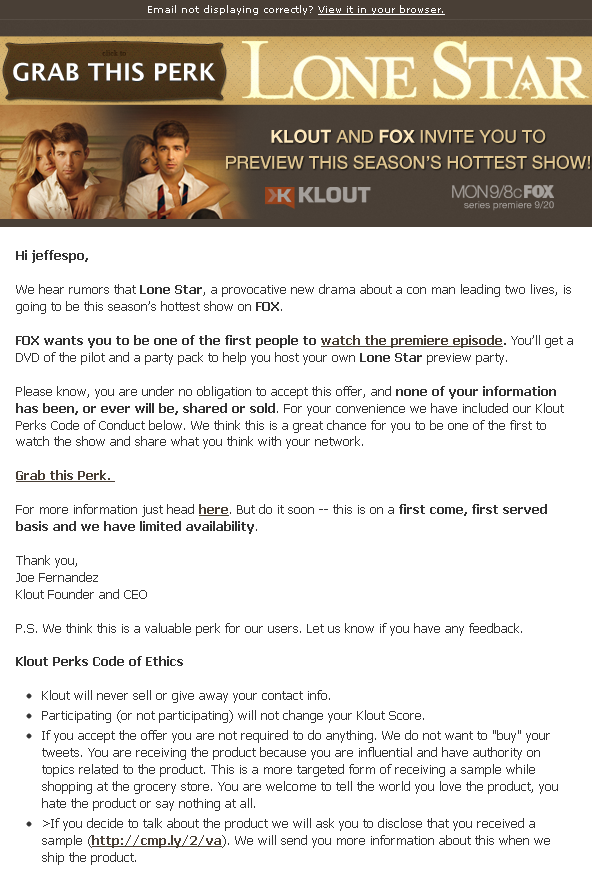
Last week I received an email from the folks at Klout informing me that Fox wanted to send me a watching kit for its new television series Lone Star. I am sure that some of you reading this got the same email.
I’m not required to do anything for them but they mailed me a promotional package and I can talk about the show if I want to. Disclosure – I love free stuff, seriously. The popcorn tin and tailgate beer mugs were pretty sweet. Now don’t take this post as an endorsement – I watched the show and was not crazy about it. I am also not a television critic so my level of expertise on the matter is also questionable, which is what makes me wonder why I was selected as an influencer for this campaign. I am simply using this as a question of influence. Disclosure #2, I do not see myself as an expert or authority in anything; I am just a guy who loves his job, but if you want to send me free stuff go ahead. 😉 There I said it. Continue reading →
Mere weeks after the PR world was shocked with news of unethical product review practices of client-developed iPhone apps by Reverb Communications, the profession is again faced with revelations of supposedly unethical practices, this time stemming from the undisclosed use of paid spokespeople by the toy industry as supposedly third-part, objective experts on local TV newscasts throughout the country, as Los Angeles Times media columnist Jim Rainey chronicled last week.
This glaring example of ethical misgivings from the toy industry brings clear an ugly truth in the new world of public relations: what is often best for the client is increasingly winning out over what is most ethical and best for consumers.
And that’s bad news for anyone serious about seeing the profession evolve and thrive. Continue reading →
So you’re actively engaged in this whole social media thing, and you’ve even figured out how you’re going to keep track of it. You’ve chosen a few tools that came highly recommended, you plugged in all the right information and now those tools are collecting data for you. All the time.
Now what?
With seemingly unlimited amounts of data coming at you in real-time, how do you make sense of it all? I’ve often been advised to look at it from the CMO’s perspective. What are the big bullet points that they would need to know? What are the insights?
Forgetting for a minute that very few of us actually have any first-hand experience knowing what a CMO wants, I wanted to walk you through my process for gleaning insights. After working in the media analysis business for two years now, I’ve found that often learning what to do with all that data can be just as tricky as finding the right data in the first place. Continue reading →
Ever notice how Twitter chats are a lot like night classes in college? Night classes happen once a week and often begin with small talk. We even show up early to catch each other up on the current events since last week. Twitter chats are very similar. We tune in once a week and make introductions detailing where we work, and perhaps a random fact just for fun. For example, “Hey #chat, I’m Stina from NYC and work as a travel publicist. Oh, and I’ve kissed Ricky Martin!” Okay sure I may not use that fact (yes, it is true, take a look at my bio) but you get the point. It’s meant to be fun. Chats are meant to be informative and laid back. But what happens when having fun simply becomes noise?
I’ve noticed in a lot of chats the witty banter, especially in the beginning, “Hey John, haven’t seen you in a while. How ya been? How are the kids? #chat”.
Please explain to me why the chat hashtag is used? Does this benefit anyone trying to participate in the chat? I’m all for making small talk Continue reading →
It started, as these things tend do these days, with an innocuous tweet; the tweet in particular was about Twitter lists. After a torrent of @ replies and emails, it was determined I needed to flesh out a post for a newly formed blog focusing on public relations as, it turns outs, there are some things that cannot be described in only 140 characters. And thus, my entry into the world of competitive blogging organized chaos.
That was a year ago. A complete revolution around the sun has come and gone since I first submitted a guest post to PRBC, a post in which I subtly make fun of both the blog and a little less subtly, the narcissistic nature of social media. As regular readers of this space, or even naturalized citizens of the world wide web, you know that not much has changed. Sure, there are more people coming here to read their daily fix of public relations banter, and sure, there are more people using social media, but what’s changed? Continue reading →
Last week, the University of North Carolina rolled out a new social media. Instead of increasing access to student athletes, the policy has coaches and/or administrators serving as the social media director for their team (read more here & here). Seems a bit extreme pulling folks more astute with X’s and O’s and game planning to monitoring 140 character messages.
Aside from tapping our resident sports guys, we also tapped into the psyche of a pair of UNC alumni to see what they thought of this new plan. For those of you counting at home, there are four contributors to this post, a first for PRBC.
True Engagement Rebecca Denison – Class of ’09
I spent four years walking around campus just hoping I’d get to catch a glimpse of guys like Tyler Hansbrough and Danny Green. At Carolina, tests and presentations were often rescheduled because the team had made it to the next round of the tourney. I will forever bleed blue and cheer for Roy’s boys.
When guys like Marcus Ginyard started to join Twitter, I was thrilled because it was probably the best way for me to get to know UNC players and show the team support. Censoring and monitoring these guys only takes away the authentic interaction they have with fellow classmates who may not get the chance otherwise. Yeah, that sounds a bit lame, but wouldn’t you want to interact with a basketball legend one-on-one if you could?
Beyond this loss of authenticity, the spirit behind the new rules is also an issue. UNC’s undergraduate journalism program is considered one of the best in the country, and to have the school’s athletic department enact a policy like this is just plain embarrassing.
Unofficial Ambassadors Aven James – UNC Class of ’06
UNC recently unveiled an updated social media policy that has been called “harsh” – and while the UNC alum in me might agree, the B2B PR pro has to admit the policy just makes good business sense. And let’s be honest – isn’t college athletics really a business these days?
Though I admittedly haven’t seen the whole policy, it addresses a number of issues we’d advise a client to touch on:
● Responsibility & Good Judgment: Student athletes, whether they like it or not, are representatives of their University. As such, they need to exercise good judgment when posting on public forums and refrain from comments that could negatively impact the “organization.” And the “organization” needs to pay attention to what’s being said.
● Audience: Students and fans are an important audience for UNC athletics. They’re the “consumer;” the buyer of UNC’s “product.” Therefore, UNC has a responsibility to consider what posts/comments might alienate its fan base.
● Consequences: A sound social media policy should address the consequences for “bad behavior.” UNC has experienced first-hand the risks associated with social media and they’ve created a policy that, they hope, will mitigate them.
All that being said, the devil is always in the details. With the ability to monitor and even remove posts, UNC could take the policy too far – and if they do so, miss out on an opportunity to engage its fan base via social media.
Pro v. Student Mike Schaffer
Congratulations, NCAA! The University of North Carolina has helped you further blur the line between enrolled student and paid employee. In Chapel Hill a coach or administrator will be monitoring players’ social media accounts for violations. Yes, that’s a public university chipping away at the students’ individual rights – sounds a little fishy to me.
How much control over a person does their university have over them? Should they have access to student-athletes’ social media accounts, as the policy demands? And why just student athletes? What about student government, student media or student workers? Seems like the college is flexing their muscles to protect their revenue generating assets.
Do you actually think the star point guard will be judged on the same scale as the back-up women’s coxswain?
I’m all for educating players on how to be on their best behavior online, on the field and in daily life. However, the UNC plan, as it’s been presented, is all about “Big Brother Watching.”
Learning is Learning Jeff Esposito
It may sound crazy, but this policy is a good thing. While my co-contributors raise some valid objections, they are missing the silver lining in this grey cloud. College is a place for kids to get an education and foundation for a future career. Sure some of the players affected by this new policy will play with balls for a living, but the vast majority of the student athletes will not.
Either way, they need to learn the professional implications of being a dumbass on social media. We’ve all heard horror stories of people getting fired and some of us even monitor what is being said about a company online and may see dumb things posted co-workers.
Sure getting to know these athletes may be cool, but they are representatives of a brand. How many brand reps do you know that really give 100% behind the scenes access? Twitter is big business and if that means some big brother so be it.
The athletes who do turn pro will have stricter regulations from their respective leagues. Just as Chad Ochocinco how much a tweet can cost.
Well there you have our in-house experts’ perspectives. What do you think of the issue?
Aven James
Rebecca, Mike, and Jeff are PRBC regulars. You can get their contact info and details, as always, right here. Aven James, a first time PRBC contributor, is a Senior Account Executive at Bliss PR (yes, Elizabeth Sosnow’s firm – another PRBC regular) where she focuses on media relations in the B2B and professional services sector.
We’ve all gotten them – those dreaded auto direct messages – Those automatically generated messages that you get as soon as you follow a new person on Twitter. I am guilty of having used them for about a week around 18 months ago, until I realized it was a pretty crappy way to interact and didn’t actually save me any time or anything else.
Yet, no matter how much we all complain about them they seem inescapable. Hoping to cast a spotlight on this wretched behaviour I’ve compiled, with the help of some friends, some of the most rude, bizarre, and simply unexplainable auto-dms we’ve received — all neatly categorized for your reading pleasure…with the occasional editorial comment from me… Continue reading →
I recently read a blog post from Dave Fleet that really put words to something that I had been pondering for a bit. The piece was entitled Are you creating social media scorched earth? It focused on companies that burn bridges with customers with one-off social media accounts.
There is no question that social media is the hotness for the 2010-2011 fiscal years for companies. Communications and customer service folks have been utilizing tools and building communities and brand awareness while driving revenue as a secondary benefit. The dollars brought in from people who are generally not seen as revenue drivers has given marketers a set of green blinders. You know the ones, where money clouds one’s thoughts, especially when the entry point into a medium is virtually free and is a direct outlet to customers. Continue reading →