In case you’re still not convinced about Twitter as a research tool, Twitter’s CEO, Jacky Dorsey, recently gave some wise advice at The Economist’s Ideas Economy: Innovation event:
It’s never been easier to start a company since Twitter exists. We get this instant pulse of what’s happening around any topic.
Let’s face it: Twitter is not for everyone. Not every company or every brand should have an official Twitter handle. I think we will all be happy if our toilet brush never says hello to us in 140 characters.
Yeah, but guess what, lots of you are still doing it wrong. It’s not just a matter of being on Twitter but also of how you interact (assuming that is, that you interact), and what you send out to the world to make sure your digital footprint is as deep and defined as you’d like it to be.
Let’s face it, just like some other things (swimming and sparring have been used as examples recently) – you can know how to do it “by the book,” but until you feel water on your skin or a jab to the face working with the tools and on the platform isn’t the same beast at all.
So, to figure out if you’re actually doing it wrong, take this quickie quiz and see where you fall. You might be doing it wrong if… Continue reading →
Marketing and PR continues to become more complex as there are more and more accessible methods for consumers interact with brands and with each other. Making sense of all the possibilities is a daunting task. Everyone is familiar with the basics like Facebook and Twitter—but what else is there? While Facebook and Twitter are regarded as engagement tools, the clutter of many-to-many conversations does diminish a campaign’s impact and effectiveness. This is precisely where crowdsourcing can fit in as a way to cut through the noise and build meaningful connections with your consumers or community.
Crowdsourcing, or co-creation, is a fun and engaging marketing and PR tool to get a community of participants activated and engaged leading up to an event or as part of a campaign. Building a campaign around crowdsourcing can be a quick and easy way to mix things up and get people talking with little or no cost. Continue reading →
As we all seek to understand social media and the digital space, more and more folks seem to be looking for the easy answer to the question, “what is an online fan, follower or connection worth?”
There have been some polarized theories and valuations, but it seems that the true answer is actually quite simple (though not easy): it depends.
While I could foresee a template or framework in the future, most of us are still trying to figure this out for ourselves. And the answers will vary widely, but figuring out what a fan or follower is worth to you shouldn’t be impossible. Continue reading →
Lately I’ve been thinking a great deal about social media impressions. More specifically, I’ve been wondering why they don’t really exist.
There are blog posts and seminars cropping up every week that want to teach you about this thing called social media measurement. And while the lessons are not always identical, I find that the overarching message is the same: there is no silver bullet. There are general guidelines, examples and maybe even best practices. But there’s not one easy solution.
Social media is still an untamed beast, and we have a lot to learn before we can truly make a connection between a specific blog post or tweet of Facebook message and some kind of consumer behavior. This is pretty much considered the holy grail of social media.
If I decided to try a new brand of sweet tea, I’m sure the company would love to be able to tie it back to one of their Facebook status updates. Unfortunately, without asking me at the grocery store which post drove me to buy, there is no real way to be sure. Continue reading →
Did I lure you in with my snazzy headline? Yes? Okay great. Now I’m going to spend the first few sentences using buzz words so that you will keep reading my social media post. Then after you’ve gotten through the first couple of paragraphs, I’m going to provide you with these awesome bullet points packed with information that you already knew. Lastly, I will summarize the topic which pretty much has nothing to do with my headline that I created for SEO purposes.
Does this situation sound familiar? Every day my inbox and RSS feeds pile up with articles about social media. The articles seem to always be about the same topic but recycled, rehashed, rewritten – they are offering me nothing of value. If you are like me, you’ve probably about had it. Continue reading →
A roundtable discussion of agency executives from the Worldcom Americas Region Health Care Practice Group indicated that interest, expectations and budgets for leveraging social media are increasing considerably across all sectors of health care clients, and budget increases are being instituted for 2011 programs. Agency experiences – coast to coast – were almost universally the same.
Worldcom is the world’s largest partnership of independent public relations firms with 112 offices located on five continents. The Worldcom PR Group’s Health Care Practice Group has 50 members worldwide, all of which have a specialty in the market segment. A dozen of the 20 Americas Region firms participated in the roundtable. Continue reading →
Perception is a huge game changer in the public relations industry. If you can swing the public’s opinion of a brand from a negative view to a positive light, you’re essentially golden. Perception is not black and white—in fact that is hardly the case—and it definitely does not always have to be viewed as just positive or negative. Sometimes PR pros have to change the public’s opinion from one overarching association to the realities of the day-to-day mission. This can be tricky especially when media coverage tends to be higher during the anomalies.
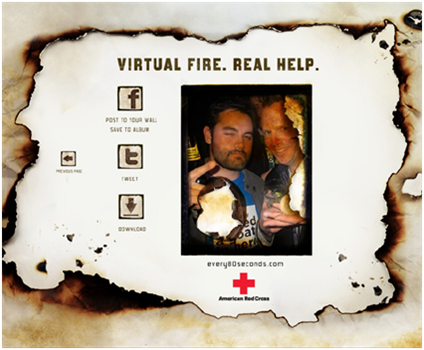
For the American Red Cross, this game of perception has become increasingly challenging. The public sees the organization as a humanitarian non-profit that deals with blood and large scale disasters. While this is true, it does not represent the single largest disaster that the Red Cross responds to across the nation. And quite frankly, people need to know the truth. Home fires destroy memories every 80 seconds. Continue reading →
I’ve wanted to tackle the subject of social media and profanity for a bit now, especially when I read this post about the persuasive power of swearing. When you are communicating in an open platform such as Twitter and you are a representative of your company, when is it okay to swear…or is it ever?
As the post and a book that I will be reviewing next week (hint) both demonstrate is that there are indeed positives to using expletives from time to time. For example, light swearing can show your passion for a particular subject and draws in your audience to pay attention. You might also find yourself in an argument and have to use stronger wording to express your point of view.
In person, I’m unfazed by people that swear up a storm. However, when I see someone send out a tweet using a naughty word, my eyebrow raises a little. Not because I’m offended but I wonder if that person just turned off his/her audience. It seems that the more we tweet and update our Facebook statuses and develop deeper personal connections, the result is that we have the tendency to act more casual. Continue reading →
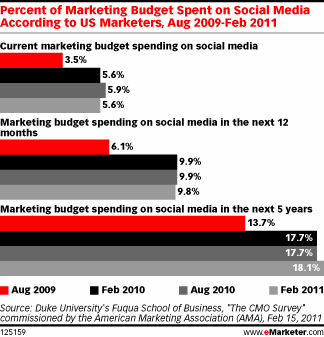
The CMO Survey looked at the rate of integration of social media within companies’ marketing mix, as well as how well social media is actually being integrated. Some of the results were quite surprising. Let’s take a look at the key takeaways:
Over the next 12 months, social media spending will nearly double to 9.8% of surveyed CMO’s marketing budgets, up from a current level of 5.6%.
In the next five years, that percentage will increase to 18.1%.
Service companies on the B2B and B2C will experience the biggest increases, as they look to promote product-focused digital and social media initiatives.
via eMarketer
That’s the good news. The bad news, however, is that the confidence level among CMOs that they and their companies are successfully integrating social media into more traditional work and marketing strategies lags behind the increase in spending.
According to eMarketer, a full 25% of survey respondents said social is not effectively integrated at all within their companies. So, on the plus side, budget allocations toward social media are up — significantly — with the expectation that it will continue to rise in years to come. But, we still have a ways to go before we can say that yes, social media is as fully integrated and understood within marketing services as more traditional service offerings.
The timeliness of this report couldn’t have been better, as recent trends, revenue reports and a general feeling of buoyancy within the PR and ad industries point toward big agencies going into a buying and M&A frenzy to boost their agencies’ digital chops, as I wrote about last week.
As PRWeek pointed out in a recent editorial, “right now the conversation in PR is all about social media and digital, and no agency can seemingly have a glut of these skills and services on hand.”
The question is, will our industry’s bravado in the digital sector match clients’ expectations for top-level digital and social media services that just two years ago, we couldn’t match, and even now, ad agencies are chomping at the bit to reclaim?
Confidence is on the rise right now in PR; but do our marketing industry counterparts feel the same bluster?